
Since January, I’ve been thinking a lot about “Theatrum belli” or War Theater. In war, a theater is an area where important military events happen. It can include all the airspace, land, and sea areas involved in war operations.
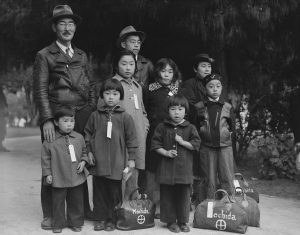
1942: Members of the Mochida family awaiting evacuation bus. (Source: Wikimedia Commons; Photograph by Dorothea Lange)
Last month, I attended a lecture by Haruka Sakaguchi, curator of “The Camps America Built.” I learned that the US military sent photographers like Ansel Adams and Dorothea Lange to take posed photos of Japanese people in concentration camps. These photos were meant for two audiences: the general US public, to justify the violation of civil rights of Japanese and Japanese Americans, and antiwar groups and people of color protesting the government, who were seen as internal threats to democracy. These staged photos, movies, and war ads were all designed to make the public accept the violation of people’s rights as necessary for peace and safety. It was all theater to condition and co-opt.
A lot of politics today feels like theater. While it may seem new and extreme, most of it is based on old scripts. Concentration and labor camps, as well as war detentions of those declared enemies without due process, are not new. The disappearance of people by our government is not new. The government violating people’s civil rights is not new.
During the first morning of Crossroads’ Toward Liberation workshop, participants learn about the work of Dr. Lee Anne Bell. Dr. Bell teaches a storytelling method that helps us critically examine the narratives that shape our understanding of reality. As participants revisit history, the words of legal scholar Sora Han start to make sense: “The United States is not a nation at war. The United States is war.” The rhetoric of war is common in the US: war on drugs, war on poverty, war on crime, war on terror, war on wokeness. And with that rhetoric comes dehumanization because, in war, there are always enemies.
The thing about theaters and plays is that at some point the audience notices the curtain hiding the backstage. When we do, something changes. The last couple of weeks have been filled with actions revealing the backstage. From Tesla protests to disrupted town hall meetings, people aware of the theater’s aims are rising to declare we see what is happening and we oppose it. Yet, history has shown us that if the resistance is not equipped with tools to interrupt the war conditioning, it too will reenact the dynamics of the war theater.
I know it may be hard to accept this metaphor of war. After all, our lives do not resemble what we see on television and the internet. Yet, if you are a person of color and an immigrant watching the US government erase your history and declare you an enemy, a transgender person wondering where to live with full rights, a poor person wondering if cuts to the safety net will push you into homelessness, a Palestinian or Muslim student wondering if you will be kidnapped for your advocacy to end a genocide, for these people today the US is a war zone. Now more than ever, it matters that we are not lulled into complacency simply because our war is not like other wars.
For almost 40 years, Crossroads has been working for racial justice, always hoping for a day when we could stop. But now is not the time. There’s too much work to do. So, until that day comes, we will be here, organizing, training, and holding space for people to critically analyze and gain the tools needed to disrupt the distorting theaters that destroy our communities. Will you join us?
Wondering what you can do? Here are some ideas:
- Sharpen your analytical lenses: Attend a workshop like Crossroads Toward Liberation to equip yourself with frameworks and tools to resist the theater of war.
- Tune in to voices that assist our resistance: I can’t imagine making sense of this time without listening to “Assembly Required” by Stacey Abrams and “Amicus” by Dalia Lithwick.
- Engage your representatives at every level: Call their offices weekly to demand action. Attend their meetings. Write letters. Make your voice heard.
- Support organizations defending people’s rights: The attacks against DEI have been costly. The war against wokeism has effectively erased the goals of this work. Organizations defending people’s rights, educating the public about history and disparities, and advocating for access and inclusion are trying to build a society where everyone can thrive. These organizations need your support more than ever.
Recent Comments